November 10, 2026
Episode 15: Ice-cream for Breakfast: Writing Your Life with Donna Rankin Love
Listen On


Why do our stories matter?
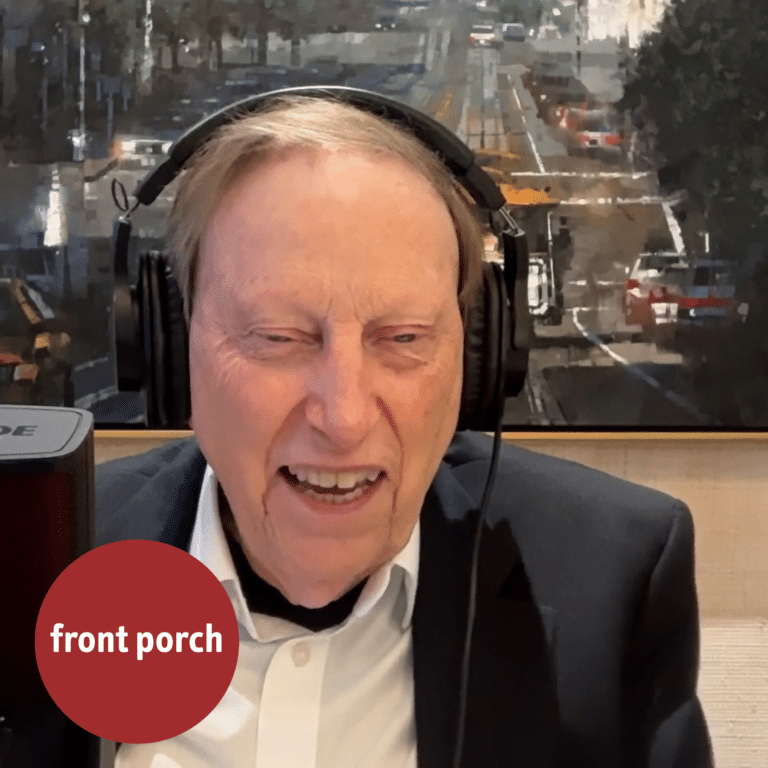
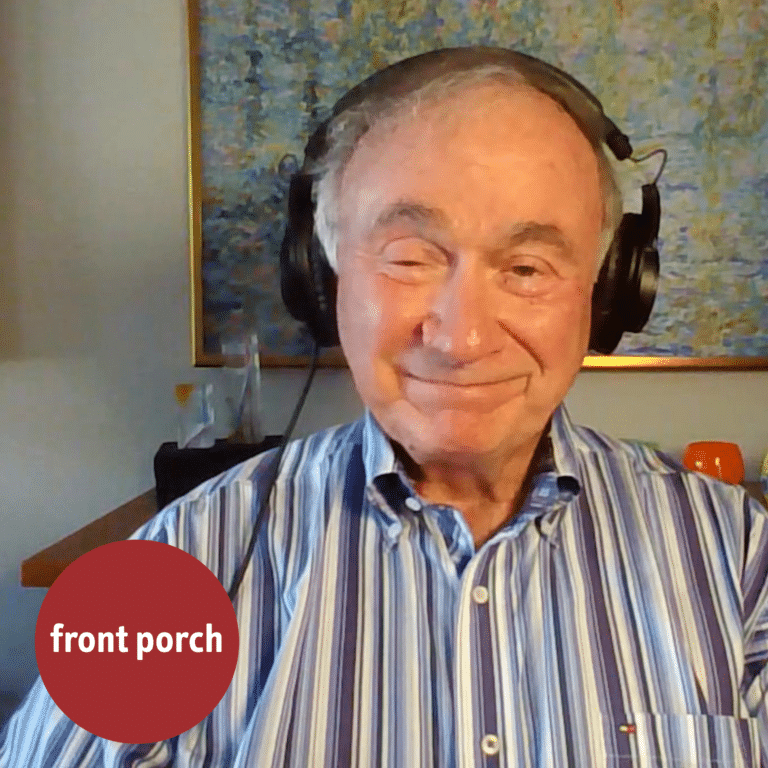
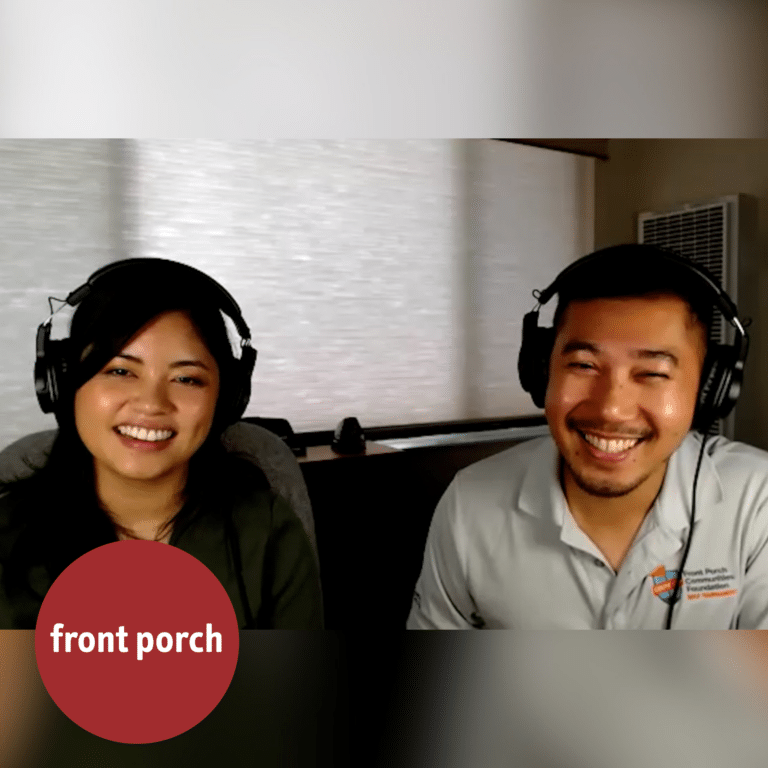
At 99, Donna Rankin Love has accumulated more than years—she has accumulated stories. In this episode of The Front Porch Podcast, host Anna Hall talks with Donna Rankin Love about rebuilding her life after divorce, walking 3,500 miles across America for peace, becoming an author in her 80s and teaching residents to write their own obituaries. Along the way, she shares lessons about courage (and her personal life hack: ice-cream for breakfast) and why our stories may be among the most meaningful gifts we leave behind.
Chapters
- 00:00 — From Doing to Being: Anna introduces the idea that aging can bring a shift away from achievement and toward simply being. She introduces Donna Rankin Love, who has spent a remarkable life learning, creating, teaching and telling stories.
- 02:07 — What Does 99 Feel Like?: Donna reflects on celebrating her 99th birthday and why getting older has been interesting rather than discouraging. With age, she says, competition and ego can diminish, leaving more room to simply be.
- 04:16 — Writing Your Own Obituary: After seeing how differently she and her brother remembered their mother, Donna began wondering why people don’t tell their own stories. Today, she leads workshops that help people write their own obituaries and reflect on what they want others to remember.
- 05:46 — Finding the Courage to Tell Your Story: Writing about yourself can feel surprisingly difficult, especially for generations taught not to draw attention to their accomplishments. Donna explains how a little humor—and even ice cream—can help people find the courage to begin.
- 07:18 — Why Our Stories Matter: Donna believes life stories give future generations a sense of where they came from while also helping writers make sense of their own experiences, relationships and past.
- 08:20 — Becoming a Writer in Her 80s: Donna didn’t publish her books until her 80s. She explains that the turning point wasn’t deciding to “be a writer”—it was realizing she had something she wanted to say.
- 09:28 — Walking Across America for Peace: Born with a foot condition that doctors said would prevent her from walking, Donna went on to walk thousands of miles across the country in the 1986 Great Peace March for Global Nuclear Disarmament.
- 11:30 — From Tourist to Activist: Donna began the peace march largely as a way to see the country, but a conversation with a classroom of fourth graders changed her perspective. Asking children how they could create peace made her ask the same question of herself.
- 12:35 — Finding Her Voice: Speaking publicly about the peace march helped Donna discover confidence she didn’t know she had. She reflects on how courage and confidence often emerge not before we act, but because we act.
- 13:50 — Writing Walking for Our Lives: Years later, while facing a cancer diagnosis and sorting through memorabilia from the march, Donna turned the experience into a book. Its message: we are often capable of far more than we give ourselves credit for.
- 15:45 — Curiosity About Death: Donna speaks candidly about her cancer diagnosis, mortality and why she doesn’t approach death primarily with fear. Instead, she describes a sense of curiosity about what may come next.
- 17:25 — A “Box of Darkness” Becomes an Opportunity: Donna reflects on the unexpected end of her marriage and how an experience that initially turned her life upside down eventually became an opportunity for independence and growth.
- 18:30 — The Courage to Ask for Help: Suddenly responsible for financial and practical decisions she had never handled before, Donna gathered experts around her dining room table and asked questions. Learning to seek help became an important part of rebuilding her life.
- 19:40 — Creating a School for Students with Dyslexia: After learning techniques for helping students with dyslexia, Donna transformed her home into a tutoring center. What began with a few students grew into a program that helped young people discover how they learned best.
- 22:35 — Knowing You Made a Difference: Donna remembers a former student who once struggled academically rushing up to tell her he had earned an A in creative writing—a moment that showed her the lasting impact of her work.
- 23:15 — “It’s a Good Way to Live”: Donna reads from The Kind of Village This Is and reflects on life at Spring Lake Village, where community means both giving help and being willing to receive it.
- 24:45 — Independence, Interdependence and Community: A simple act like tying a neighbor’s shoe becomes an example of how community works. Donna and Anna discuss the freedom of maintaining agency while knowing that people around you are willing to help.
- 25:35 — Give While the Season of Giving Is Yours: Rather than waiting for her belongings to be distributed someday, Donna is giving meaningful possessions to family members now—along with the stories that make those objects significant.
- 26:55 — The Freedom of Letting Go: Donna discusses the courage it took to leave her longtime home and move into senior living. Letting go of places and possessions doesn’t mean losing the experiences connected to them; those remain in our memories and stories.
- 28:05 — Why Stories Endure: Donna closes by explaining why she believes storytelling is one of our most powerful forms of communication. Facts can be forgotten, but stories connect with both the mind and the heart.
Key Takeaways
- Aging can shift our focus from doing to being. After decades of striving, achieving, parenting, working and meeting expectations, later life can create room for reflection, curiosity and simply experiencing who we are.
- Courage often comes after we act, not before. From public speaking to walking across America, Donna repeatedly discovered that confidence grew because she took the first step.
- Our stories are part of our legacy. Writing about our lives helps future generations understand where they came from and gives us an opportunity to make meaning from our own experiences.
- It is never too late to begin something new. Donna became a published author in her 80s and continues writing, teaching, learning and contributing at 99.
- Asking for help is a form of strength. When Donna had to rebuild her life after divorce, she sought out people who knew what she didn’t and allowed herself to learn from them.
- Adversity can contain unexpected possibilities. Divorce, illness and major life transitions became catalysts for growth, independence, creativity and new directions in Donna’s life.
- Community is built through interdependence. Living well doesn’t require doing everything ourselves. It means having the freedom to both offer help and receive it.
- Giving can be more meaningful while we’re here to experience it. Donna’s practice of giving possessions—and the stories attached to them—to loved ones now turns letting go into an act of connection and joy.
Guest Bio
Since turning 80, Donna Rankin Love has written and published four books of stories based on her rich and varied life. Raising four sons. Remodeling houses in Mexico. Running a tutoring center for students with dyslexia. Walking across America in the Great Peace March for Nuclear Disarmament. She currently lives at Spring Lake Village where she teaches a class on how to write your own obituary. To people who are intimidated by writing their lives, she says, “Write your lives one tale at a time. Remember, you don’t have to start at the beginning.”
Host Bio
Anna Hall is a purpose-driven leader with over 25 years in senior living, spanning employee engagement, life enrichment, training and innovation in age-tech and program design. A certified life coach and dynamic speaker, she helps people connect with meaning and motivation at every stage of life. She is the creator of The Purpose Equation®, an evidence-informed framework that empowers individuals to define and activate their unique purpose to enhance wellbeing, engagement and collaboration. As Chief Culture & Community Officer at Front Porch Communities & Services, Anna leads initiatives that foster belonging, creativity and human thriving—building communities where everyone feels valued and inspired to make a difference.
Resources Mentioned
- Front Porch Communities and Services — A nonprofit organization providing senior living communities, affordable housing communities and other programs and services
- Spring Lake Village, a Front Porch Community located in Santa Rosa, California
If this conversation resonated with you, share it with a friend, subscribe and leave a review to help others discover the show.
Listen On
Disclaimer
The views and opinions expressed on this podcast are those of the speakers and do not necessarily reflect the views or positions of any entities they represent. This podcast is for informational purposes only and should not be considered, legal, health, tax, or professional advice. Always consult a licensed professional for specific advice related to your situation.
Anna Hall: We’re taught from a young age to value independence. But what if our true strength is our ability to connect with others? Through conversations with the fascinating folk who live and work at Front Porch Communities and Services, we explore how community shapes us, how we can learn from people in every stage of life, and how each of us makes an impact in our own communities and beyond.
Welcome to The Front Porch Podcast. I’m your host, Anna Hall. I have been so fortunate to work in this aging services space for my entire career, over 25 years, and I believe that I’ve stumbled upon some of the knowledge and wisdom that is gained from living a long time, otherwise known as aging. And one of the phenomenon that older people tend to, tend to understand is that there’s a difference between being and doing. So, Donna, thank you in advance for sharing with us what you have learned about being and how your sense of being has helped you make an incredible difference in so many lives.
Since turning 80, Donna Rankin Love has written and published four books of stories based on her rich and varied life: raising four sons, remodeling houses in Mexico, running a tutoring center for students with dyslexia, walking across America in the Great Peace March for Nuclear Disarmament. She currently lives at Spring Lake Village, where she teaches a class on how to write your own obituary. To people who are intimidated by writing about their lives, she says. “Write your lives, one tale at a time. Remember, you don’t have to start at the beginning.”
Donna, thank you so much for joining us on The Front Porch Podcast.
Donna Rankin Love: You’re welcome. I’m happy to be here.
Anna Hall: I hear that you’ve recently had a birthday.
Donna Rankin Love: Yes. Yes I did. In September, I had a birthday.
Anna Hall: And how many years are you celebrating?
Donna Rankin Love: That was my 99th birthday.
Anna Hall: Happy birthday.
Donna Rankin Love: Thank you.
Anna Hall: Do you feel any different being 99 than 89?
Donna Rankin Love: Oh, then 89? Probably. I felt that 80s was a period in which we could begin to get used to the idea of being old. And by the time I reached 99, I definitely accept the fact that I’m old. But the surprise of about the birthday is that nobody pays a whole lot of attention to 99. Everybody focuses on 100. And so you expect a crown, a big cake, lots of candles with all the family gathering around. But for 99, it was surprising to me that there was celebration after celebration. It does sound old, doesn’t it? I’m not really depressed by it or anything. I find it interesting to get older.
Anna Hall: What’s the most interesting thing about getting older?
Donna Rankin Love: Well, one of the most interesting things is that we’ve already won the race. All we have to do is run it. We have to be in it. That’s it. But we’ve already won it. So we don’t have to struggle with achievements or there’s competition goes away, ego diminishes. And so it’s not as competitive. And it’s more philosophical. We I think spend more time being… that’s it being. We spend more time being than doing.
Anna Hall: It sounds like a relief in a way.
Donna Rankin Love: I think it is a relief. It is a relief. And you know, in every stage of our lives we have challenges. You know, we had… we had to get good grades in school. We had to be a good parent. We had to be a good wife. We had to be achieving all along. Now all we have to do is just be. We’re still here.
Anna Hall: And it seems that because of this gift that you are living in right now at 99 years, that you’re also thinking about legacy and helping others in your community to write their own obituaries while they’re still alive.
Donna Rankin Love: When our mother died, my brother David had written the obituary and asked me if I would check it out, to be sure that it was accurate. I read it and it looked like he was talking about somebody entirely different than the woman I knew. David is ten years younger than I, I’m the first born. He was the last born. He saw her as in a different way than I had. And I realized that we couldn’t really be accurate unless we both wrote it. But then I thought, wouldn’t it have been great if she just written it herself? It would have been accurate and would have been a lot easier on us. And that’s what inspired me to maybe help other people write their obituaries. An obituary is really very much like a memoir, and I’d already had memoir working shops, because I believe that the that we need to tell our stories so that our children and upcoming upcoming generations know where they came from. So I just I have a four hour workshop. And they finished that four hours with a the running gears of a good, complete obituary.
Anna Hall: Do you ever find that that shift from writing a memoir to an obituary brings up fear for some people about death?
Donna Rankin Love: Fear about death… I think when they begin, when they come into the room for the workshop, that she…they’re apprehensive and think it’s going to be really grim and serious and scary. But it’s not because… what are they doing? They’re writing about their achievements. They’re not writing about things that didn’t work. The difficult thing is that we, at least women in my generation, were taught not to call attention to ourselves. So certainly not brag. Just be nice and be… be quiet and don’t talk about your achievements. So they have to get over that. That’s the biggest hurdle.
I had a friend in Santa Cruz where I lived, who told me about her third grade daughter, who came down to breakfast one morning and said she didn’t want to go to school, that she was afraid to go to school. Her mother was a really smart woman, said, “I understand, honey, I understand that sometimes you get afraid and you just don’t want to go. And you need courage in order to face those times.” And they talked about courage. What is it? And the little girl said, “How do I get courage?” And the mother said, “Well you eat ice cream for breakfast.” And so they had ice cream on the cereal, and the little girl picked up her book bag and skipped off to school. And so I serve ice cream at our workshops. And sure enough, people have the courage to write about themselves.
Anna Hall: What do you see as the benefit for people of writing about themselves? Having the courage to sit down and look back at their life and also face that life is not forever?
Donna Rankin Love: The main reason that I want people to write about themselves is that a study, a sociological study in New York City, done probably 20 years ago now, showed that children who knew their context who knew where they came from are more flexible, more curious, more confident than those children who who didn’t have that. And I think that gift is well worth giving. But they also get a chance to make sense out of things that have happened. Sometimes they, they find that their mother maybe was grouchy or was too severe or not encouraging enough. And so in in understanding that we can forgive those shortcomings and we create peace in the world that way. Not a lot, but some. And it’s significant.
Anna Hall: Have you always been a writer?
Donna Rankin Love: I have written four books, but I wrote them when I was in my 80s because I had something to say. That was the important thing. I’ve always liked words. And our mother was very well spoken. And so I’ve been conscious of words in the meanings, but, oh, I did do some writing. When I went on the peace march, I was 59, and I knew the woman who worked for the local newspaper, and she asked me to write feature stories. But that was just reporting things. That wasn’t really, it wasn’t creative, hardly at all. It was just giving the facts of what was happening.
Anna Hall: So let’s go into that peace march. You walked a very long way. But before we get to that story tell me about your feet. When I born, I was born crippled and my feet, the tops of my feet bent up toward almost touching the shins. And the doctor said, “this child will never walk.”
Anna Hall: Oh my goodness.
Donna Rankin Love: My mother was feisty woman. And she said, “you want to bet?” And she took me home and rubbed my feet down, massaged my feet down until they hit the ground. And I walked at 15 months.
Anna Hall: Donna, that’s incredible, and then you kept on walking, all the way across America with the Great Peace March in 1986. Can you please tell us more about that?
Donna Rankin Love: I heard about it when I was on a trip to Greece, and I asked a woman, also in our travel group, if she would like to walk down the hill, just straight down the hill, instead of taking the bus. She said yes. So we walked down and on the way she said, “I see you like to walk. Let me tell you about the walk I’m gonna take next year.” And the walk was called the Great Peace March for Global Nuclear Disarmament. We wanted to have no more nuclear weapons anywhere in the world, not just the United States or not just Russia. Everywhere. And we knew from the get go that we aren’t going to be able to stop that, but we’ll be able to raise the awareness of the need for that by going through walking that 3,500 miles from Los Angeles to New York City down to Washington, D.C. and talking to people on the way. And that’s what we did. I went, though, just as a tourist. I thought it was a great way to see the United States, to see our country from on foot. I wasn’t very much of an activist at that time. I was a pretty conservative, traditional, quiet, meek, gutless homebody. But that walk I went on was a great it was a great turning point in my life. In each of the towns where we stayed long enough, we had appointments to go and talk and to the community, to church groups, to any kind of women’s groups or civic groups or classrooms. And I went to a fourth grade classroom and stood up there to tell them what we were doing. And I asked them what they could do to increase peace. And one little boy said he could feed the dog without being told, and another little boy was said, I’m going to be nicer to my sister. And somebody else said, I’m going to help. And they had ideas. They had fourth grade level ideas on how to create more peace in their lives. And I thought, what am I doing? I’m asking fourth graders. I’m asking nine year olds to create peace in the world. And I’m just taking a stroll across the United States. So I walked in there, a tourist, but I walked out of that classroom, a committed peace activist.
Anna Hall: So how did you become an activist beyond going through the motions and really taking a stand?
Donna Rankin Love: When I wrote those stories for the hometown newspaper, I began saying not only what we were doing at the time, I talked about what we could all do. We also had like a speakers bureau on our walk, and some of us signed up to talk about what we were doing. So I was sitting in a row in church one day, and the minister said, “We’re happy to have guests from the Great Peace March here. Will one of you tell us what you’re doing?” And we all looked at each other up and down the row, and finally I said, “Okay, I’ll do it.” And I took the program with me and I read the saying for the day, and I could relate that to what we were doing. And I just babbled on and on. And when I sat down, I said, what did I say? How was that? Did I make sense? And they said, it was great! I guess I have something to say. And so then I kind of lost my shyness about being in front of people then. And as long as I had something to say then I was all right.
Anna Hall: That’s beautiful. I’ve heard that we gain confidence not by thinking about or wishing what we want to do, but by actually doing it. And with every step and hard thing that we do, that’s how we grow our confidence. It sounds like that happened for you. And then you wrote a book called Walking for Our Lives about that peace march.
Donna Rankin Love: I wrote that because I had to clean out the attic for some reason and, and much of the attic was memorabilia that I had brought from the peace march, and my boots and my jacket and things like that.
Oh, I know I had been diagnosed with cancer, with bladder cancer. And I thought, maybe if I’m gonna die in six months, I should clean out the attic. That’s why I was cleaning out the attic. And so I thought, well what’ll I do with all this stuff. There was a college in Pennsylvania, Swarthmore, who was creating a collection of memorabilia from peace activists. But then how, what will I do in order to keep part of it? And I decided to write the book, ‘cause that would not take up nearly the amount of room. So that’s how I started. And because I had been writing those articles about once every two weeks on the, the nine months that it took us to walk across the country, I just used those, laid those out in chronological order, and used those kind of like a structure for the book.
Anna Hall: And what is the main message of the book?
Donna Rankin Love: What’s the main message of the book? You ask very good questions.
Anna Hall: Thank you. I like, I like to learn my I love to be curious.
Donna Rankin Love: Good for you. Good for you. I think the main purpose of the book other than just, chronicling the event itself, is that we probably are capable of doing more than we give ourselves credit for.
Anna Hall: That’s a beautiful message. I’m hearing this theme of courage. And I’m also hearing that you were facing death when you decided to write this book. What was that like to get that diagnosis of bladder cancer and then take such incredible action instead of maybe being paralyzed, which I could also see could happen when you hear news like that.
Donna Rankin Love: I don’t think I was paralyzed, I don’t think… I’m not really afraid of dying. I don’t think I’ve ever been afraid of dying. When my father had his 65th birthday, I asked him if he was afraid of dying. I was just maybe 30 at the time and old age was very far away. And so he said, no, He wasn’t afraid of dying, but he didn’t want it to hurt. And that was kind of, I kind of took that on too. I didn’t want it to… I don’t want it to hurt. I think death is kind of interesting. I’m kind of curious to see what happens next.
Anna Hall: Do you have any ideas about what might happen next?
Donna Rankin Love: Oh yeah. I think we go someplace else. We don’t take up any space. We’re not physical at all. That all this physical stuff that we spend so much of our lives maintaining the physical aspect of ourselves. But there’s a little spark. There’s a little. There’s a little spirit. There’s a little something that doesn’t take up any room at all. And there are billions of ‘em. Just think how many people have died. There’s billions of them out there. I mean, after my father died, I know he didn’t necessarily come back, but he, he sent a red tailed hawk to tell me that I was doing a good job or that I’m not doing a good job about some decision I was making. So, I believe there’s something of us that lives beyond here. This is this is a very interesting period of this life. But I don’t think it’s the only period.
Anna Hall: You were a stay at home mom raising your four sons and then your husband left suddenly.
Donna Rankin Love: Do you know Mary Oliver, the poet?
Anna Hall: No. But tell me about her.
Donna Rankin Love: Oh, you would like her. You would like her very much. And one of the poems that I liked I don’t know the title of it, but the first line is, “Someone I loved once gave me a box of darkness. It took me years to learn that it was full of light.” So that’s kind of what my divorce did. I was not ready for a divorce. I had not anticipated that we were, that our marriage was going to end. But it did end. And I was thrown for a loop, and it took me a while to get my feet under me. But eventually I did. And I realized later that that box of darkness really was an opportunity for me to grow.
Anna Hall: How did you find courage to figure out a whole new life?
Donna Rankin Love: Well I asked for help. I didn’t know, I realized that I didn’t know anything. I knew how to run a house, I knew I’d majored in in psych and early childhood education. So I knew something about children But I didn’t know how to manage money. I didn’t know even what questions to ask. Probably about six months after he left, I realized I needed to know what a banker is saying and what a real estate man is saying and what an insurance person was saying, and all those kinds of functions that that are areas of our life that I didn’t know anything about. So I invited some friends. I invited a real estate man, I invited a banker, I invited a lawyer, I invited other people, CPA. Or tax man to come. And I gave them little, little cookies and coffee around the dining room table. And I had a list as long as your arm to ask them. And so I asked them all these questions, and they gave me their cards and said, if you ever need any advice, just give me a call. And that’s how I learned what all those things that men know how to do, or that I thought that only men knew how to do those things.
Anna Hall: You also started a school for children with dyslexia. What’s that story?
Donna Rankin Love: That was fun to do that. That was, I was supposed to earn some money because I was now a single woman. A friend said that she was going to take some classes about dyslexic children. That summer, there was a somebody was offering this course and would I like to go? And I said, “yeah, I would like to go.” So I went. And most of the dyslexic students were boys. I knew something about boys because my boys were now in high school. The local school district offered me a job as a special ed teacher. And I went and I did that. I substituted for a woman who was having a baby. And so I did that for a few months and, and realized that the teacher in the classroom spends a great deal of her time just maintaining order and maintaining discipline. And I just certainly didn’t want to do that.
So I carpeted the garage and lined it with books that teachers gave me. You know, when they changed their textbooks.
Anna Hall: Yes.
Donna Rankin Love: They throw away all those books. I said, bring them to the front porch. I can use them. So I insulated the garage with those books, unplugged the freezer and used it for a paper, paper file source.
Anna Hall: Your ingenuity is incredible.
Donna Rankin Love: Thank you, I’ve been active, you know, like all housewives are active in charity groups. And when I went to the fall meetings. And then when the president said, does anybody have anything to say? I raised my hand and I said, I just learned how to work with dyslexic students. But the system will work for any student. You don’t have to be dyslexic in order to benefit from this. And so if anybody has children who are having trouble reading or writing or spelling or taking tests, those are the, those were the areas that we were going to, I was going to concentrate on.
And I got some students right away. So by Christmas time, there were six of us tutoring. I had a bookkeeper and a, and a telephone service. But I never moved out of the house with the whole house was… became a tutoring center. And we had a lot of fun. They’re bright students. They just didn’t learn the way school was teaching.
Anna Hall: Wow. You became an entrepreneur overnight. A very successful one at that. But what a difference you made in those children’s lives.
Donna Rankin Love: I think so, I think so I, Phillip was a third grader when he came, and he had a couple of older sisters who were really good students, and he wasn’t a very good student, but he was, he was a smart enough boy, and we had a lot of fun, and we had him all the way through, through up through junior high. So I had probably had him for about 4 or 5 years. And eventually he got to college. And one Christmas time, he came bolting across the downtown avenue where I was just standing talking with some friends, and he said, “Mrs. Love! Mrs. Love! I got an A in creative writing!” And I thought, I did make a difference.
Anna Hall: You’re making a difference. I don’t like to say, “still.” Sometimes when we talk about older people, we’ll say, “oh, she’s still writing or she’s still doing whatever.” I don’t like that. You are making a difference every day in community now. You’ve moved into Spring Lake Village, and I love the way that you talk about community because it admits the truth, which is none of us can live on our own. We are innately social creatures. Independence is a myth. We need each other. Would you read us an excerpt from your book that’s called…
Donna Rankin Love: The Kind of Village This Is. All right. This is a, a short paragraph on page 86.
“When we live in community. Help is available from every direction. I don’t sew, Charlotte does, Vera doesn’t drive. I do. Charlene next door needed soda crackers. I had some to share. Joanie has a symphony ticket and won’t be going. Another will. Dorothy is blind. Nancy brings her to Marie’s, and Bev reads to all eight of us. Sighted or not. It’s a good way to live.”
It is a good way to live.
Anna Hall: You really are a fabulous writer. Wow.
Donna Rankin Love: Thank you. Thank you so much. It’s available on Amazon.
Anna Hall: Oh, good. I’m gonna order.
Donna Rankin Love: The purpose was to help other people make the same kinds of decisions that I was making. And somebody did say you ought to write a book. I said, “I don’t wanna write a book. It’s too much work, anyway.” But a granddaughter, a 30-year-old granddaughter said, “I know how to make a book, Gran. You get me the words and I’ll make the book.” And so that was Jenny who did it, and she took the pictures of the front of it, and saw to it that it became in book form.
Anna Hall: And again that’s an example of reaching out to ask for help and accepting help. And look what that leads to. How do people at Spring Lake Village help each other?
Donna Rankin Love: I think it’s in our attitude. I was walking along the sidewalk the other day and a woman came kind of hobbling along, and she said, “My shoes untied. I, I have to find a place to sit down.” And I said, “Put your foot up here, I’ll tie your shoe.” That takes 30 seconds. So. And then she wrote me, she wrote me a thank you note. Just for that! So, so it’s an attitude that we have. I think we’re grateful for being here.
Anna Hall: You can live your own life, make your own choices, have total agency and have help and give help. It’s beautiful. Isn’t that what life is about I think.
Donna Rankin Love: It’s the way it should be anyway. Yes.
Anna Hall: I’m wondering now what is next for you? I’m wondering now what is next for you? What’s your next step?
Donna Rankin Love: The next step is I’m giving away things. So, I’m following my mother’s advice, which she copied from Omar Khayyam, which is, “give while the season of giving is yours.” I think that’s very good advice. And so I run across little odds and ends of things in my household that I know that somebody has said when the day comes, that’s, that’s the euphemism that we use in our family. I don’t know who started it, but they say “When the, when the day comes, Mom. Could I have that? Yes you can. I’ll put your name on it. And then I turn it right around and put it in a box and give it to ‘em now if I don’t need it.
Anna Hall: Many people hold on to those things until after they’re gone. What compels you to give now?
Donna Rankin Love: Well, because it’s fun. And the I have things… I don’t have very many things compared to what I used to have. But the things that I have, have a story to them. And that’s what makes them precious to me. And that’s why I still have ‘em. And so I give. When I give something away, I give the story of it also.
Anna Hall: That’s beautiful. I think it’s incredible how what I’m hearing from you, looking back, helps you to have a clear vision of what you want to see moving forward. It reminds me of ice cream for breakfast. Can I read something that you wrote?
Donna Rankin Love: Yes.
Anna Hall: You said, “To become a resident in a senior community required courage, flexibility and money. For courage, I ate ice cream for breakfast. For flexibility, I reminded myself to keep an open mind. I sold my house.”
Donna Rankin Love: Yes, it seems pretty simple, doesn’t it?
Anna Hall: It sounds simple, yet very hard. It’s more letting go. What do you gain by letting go?
Donna Rankin Love: I think there’s a sense of freedom that comes with that. I don’t know that there’s a sense of loss. I had a really good time living at the beach for the last 20 years before I moved into the, into senior living. And I realized that I missed the beach, I missed the little house, was a cute little house, and I missed that. But ultimately, I realized what I missed was all the times that we had there and all those children who started coming over to the beach when they were very, very young were now at least in their 20s. And there and that time was gone. We’re not going to get that time back. So I have the memories of it and the, and the stories of it. I’m a big believer in stories. I think that’s a really a major, a major part of me. I’m a big believer in telling the stories. I think that if you just have a list or if you just have scientific information facts, that’s not so memorable. I think people learn more from stories than any other communication vehicle.
Anna Hall: I agree. I think storytelling touches our mind and our heart, and that connection is what helps us remember.
Donna Rankin Love: I think so too. I think you’re right. Yes.
Anna Hall: Donna, your story is absolutely incredible. Thank you so much for sharing it with us. I’m gonna start having ice cream for breakfast.
Donna Rankin Love: You can get little ice cream cones at Trader Joe’s and they’re just little small ones, but they’re good enough to get you started.
Anna Hall: Perfect. Thank you so much.
Donna Rankin Love: I appreciate you asking me all these questions. Thank you.
Anna Hall: You’ve been listening to The Front Porch Podcast. I’m your host, Anna Hall. Our theme music was composed by Geoven Snaer and Dianne Kae Enriquez. Carmen Elena Mitchell is our producer and editor. Our recording engineer is Jeff Gall. Special thanks to Laura Darling, Kate Vermillion and Joanna Aceves for production and marketing support. Tech support provided by Jonathan De Luna. Front Porch is a dynamic nonprofit organization dedicated to empowering individuals to live connected and fulfilled lives through community and innovation. In support of this vision, Front Porch provides high quality, accessible and welcoming human services through senior living communities, affordable housing communities, and other programs and services. Learn more at Front Porch.net. If you enjoyed today’s conversation, please share it with a friend and help others find us by subscribing and leaving a review. We’ll be back soon with more stories from the fascinating folk who live and work at Front Porch. Until then, stay connected and inspired.