June 18, 2026
Memory Care That Still Feels Like Your Father

For many families, the hardest part of this journey isn’t deciding whether help is needed. It’s wondering whether memory care can still honor the person their father has always been.
As families search for memory care options in Orange County, CA,— including life plan communities like Walnut Village — they are increasingly seeking something more nuanced than basic supervision. They want environments that treat identity, personal history, daily routine, and human dignity not as secondary considerations, but as essential components of care itself.
The Best Memory Care Starts With Familiarity
Memory loss changes how people move through the world, but familiar experiences retain enormous emotional weight even as cognitive function declines.
A favorite song can ease anxiety more quickly than any explanation. The smell of coffee brewing in the morning can produce a felt sense of comfort before words fully arrive. Deeply embedded routines often persist long after recent memories become difficult to access — because they live in a different part of who a person is.
That understanding should shape how a memory care community gets to know your father. It means learning how he spent his mornings for the past four decades: whether he preferred conversation over breakfast or valued quiet, whether music settled him, whether his weekends were spent gardening, fishing, reading the newspaper cover to cover, or working with his hands. Those details aren’t background information. They are the foundation of meaningful care.
Families Often Notice the Shift Slowly
Very few families arrive at a memory care decision following a single dramatic event. Far more often, the changes accumulate slowly, each one individually manageable until, collectively, they aren’t.
Medications begin to be missed. Appointments that were once handled with precision are forgotten. The house becomes harder to maintain. Sleep patterns shift. Anxiety increases in the evenings. Conversations grow more confusing or circular. And somewhere in the middle of all of it, the family members doing the caregiving quietly reach the limits of what love alone can sustain.
Many families carry guilt alongside that exhaustion, feeling that they should somehow be able to manage everything themselves. But dementia eventually requires something beyond what family caregiving can provide: consistent structure, specialized training, and an environment specifically designed to reduce fear and disorientation rather than inadvertently amplify it.
The right memory care community allows family members to step back into their actual relationships — as daughters, sons, and spouses — rather than functioning almost exclusively as caregivers. That shift matters profoundly for everyone involved.
What Daily Life Should Actually Feel Like
The best memory care environments don’t feel clinical. They feel calm.
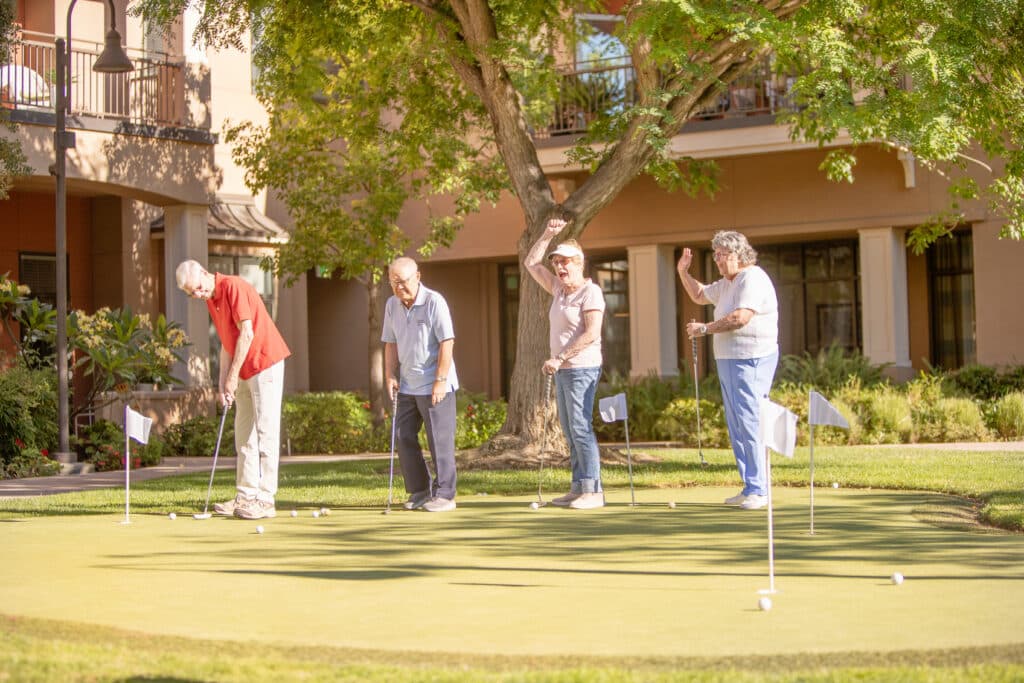
At thoughtfully designed communities like Walnut Village, daily life tends to revolve around rhythm rather than rigid scheduling. Residents move through familiar routines with gentle guidance from staff who understand that emotional reassurance is as important as any practical task. The goal isn’t efficiency. It’s comfort.
Mornings may begin unhurriedly, with breakfast near sunlit windows that look out onto garden courtyards. Music from earlier decades drifts through common spaces during life enrichment programming. Residents spend time outdoors year-round, walking paths lined with flowers, citrus trees, and shaded seating where families gather during visits. These elements aren’t incidental — they’re intentional, designed to reduce overstimulation and anxiety while supporting orientation and a sense of familiar ease.
The strongest caregivers also understand that communication itself changes with dementia. They slow down. They give residents time to process. They learn what triggers frustration and what restores calm. And they pay attention to the small, unscripted moments that reveal who a person still is underneath the fog of memory loss.
A caregiver notices your father tapping his fingers along to a jazz standard during an afternoon program. A staff member learns he still finds satisfaction in folding napkins before dinner because it echoes a routine he followed for years at home. During a family visit, he suddenly begins telling a story from his twenties that no one has heard him share in months. These moments are not incidental to good memory care. In many ways, they are the point of it.
What Families Should Pay Attention to During Tours
A memory care tour reveals far more than any brochure can convey, but only if you know what to look for.
Pay attention to the atmosphere the moment you walk in. Do residents appear calm and oriented, or overstimulated and anxious? Do staff members interact with residents naturally and warmly, or do exchanges feel rushed and transactional? Are people genuinely engaged throughout the day, or largely seated in front of televisions for long stretches?
Watch how caregivers respond during unscripted moments — when a resident is confused, agitated, or simply needs reassurance. The strongest communities don’t just manage behavioral symptoms. They redirect anxiety with patience, familiarity, and genuine emotional attunement.
Look closely at the physical environment as well. Natural light, meaningful outdoor access, smaller and more intimate gathering spaces, and quieter common areas can make a significant difference in day-to-day comfort for residents living with cognitive change. And ask, specifically, how the community learns about each resident as an individual — what questions they ask families, and how that information actually shapes the care someone receives.
Holding Onto What Still Matters
Memory care decisions are never straightforward, because they arrive carrying love, grief, responsibility, and change all at once. There is rarely a moment that feels entirely right or entirely ready.
But the right environment can offer something many families haven’t felt in a long time: genuine relief. Relief that your father is comfortable and safe. Relief that trained support exists around the clock. Relief that daily life no longer revolves entirely around fear, exhaustion, and uncertainty.
And beyond relief, the right community helps preserve dignity alongside care — recognizing that these two things are not in tension, but deeply intertwined.
At communities like Walnut Village, memory support is not simply about managing symptoms or maintaining safety. It’s about honoring routines, relationships, personality, and individual identity in ways that allow moments of joy, familiarity, and real human connection to remain part of everyday life. Because even as memory changes, the person your father has always been still deserves to be fully recognized.
FAQs
Q1. What should I look for when touring memory care communities? Visit multiple communities, ideally at different times of day, and observe how staff members interact with residents during unscheduled moments rather than guided presentations. Ask specifically about dementia training protocols, staff tenure and turnover rates, and how care plans are adapted as a resident’s needs evolve over time. The answers to those questions reveal far more than a polished tour ever will.
Q2. How long should I allow when communicating with someone who has dementia? People living with dementia often need up to 90 seconds to process information and formulate a response. When asking a question or offering an instruction, allowing that full window of time before repeating yourself or moving on can meaningfully reduce frustration and support more authentic moments of connection.
Q3. What are the signs that someone with dementia may need specialized memory care? Key indicators include safety concerns such as wandering or frequent falls, increasing difficulty with daily activities like bathing and dressing, challenges managing medications reliably, and notable behavioral changes including heightened anxiety, agitation, or significant shifts in personality. When these signs appear together and consistently, it is generally worth consulting both a physician and a memory care specialist.
Read Our Front Porch Blogs
LPGA Hall of Famer Amy Alcott Named First-Ever Front Porch Ambassador

Older Americans Month 2026: Championing Your Health at Front Porch