August 15, 2025
How is nonprofit senior living different from for-profit?
People often wonder what’s the difference between for-profit and nonprofit senior living communities and organizations. When the buildings, amenities and services are the same, what sets Front Porch and other nonprofit senior living organizations apart from for-profit counterparts?
One important difference between nonprofits such as Front Porch and for-profit organizations is how the money earned as profit (or margin) is allocated. As a nonprofit, Front Porch does not have a requirement to provide distributions to shareholders. Rather, Front Porch invests large portions of its earnings back into the organization, building and improving its offerings to residents and other stakeholders.
Despite what the name suggests, a nonprofit organization still needs to be profitable in order to continue to deliver on its mission. Although some people may wonder why a nonprofit needs to be run like a business, “Increasingly, there seems to be a deeper understanding that there can be no reasonable expectation for ‘mission accomplishment’ without a baseline level of business acumen that’s pretty high,” says Sean Kelly, CEO. “To be effective, nonprofits need effective and efficient processes, sophisticated systems and great people that deliver quality services as well as margin.”
“The biggest difference really comes down to purpose,” says Julie Hoerl, director of philanthropy for the Front Porch Communities Foundation. “Our success isn’t measured primarily by profit. Our main measure of success is in building community, the quality of life we support across our organization and outside it.”
Hoerl believes that for Front Porch, being a nonprofit is a “strategic asset,” not a limitation. “Front Porch is an organization committed to operational excellence and fiscal responsibility precisely because these disciplines allow us to be better stewards of our mission. Our nonprofit structure is a huge benefit that helps us to prioritize long-term quality and innovation above all else.”
But how are senior living nonprofits different? Senior living has some unique requirements to qualify as a 501(c)(3) that have been established by the IRS. To obtain nonprofit status, a senior living organization must be designed to meet the three primary needs of seniors: housing, health care, and financial security. Specifically, this means
- Offering housing and other facilities designed to meet the needs of older adults;
- Providing health care, either on-site or through a relationship with other nearby services or organizations; and
- Establishing a policy to maintain “in residence any persons who become unable to pay their regular charges,” and operating “so as to provide . . . services at the lowest feasible cost.”
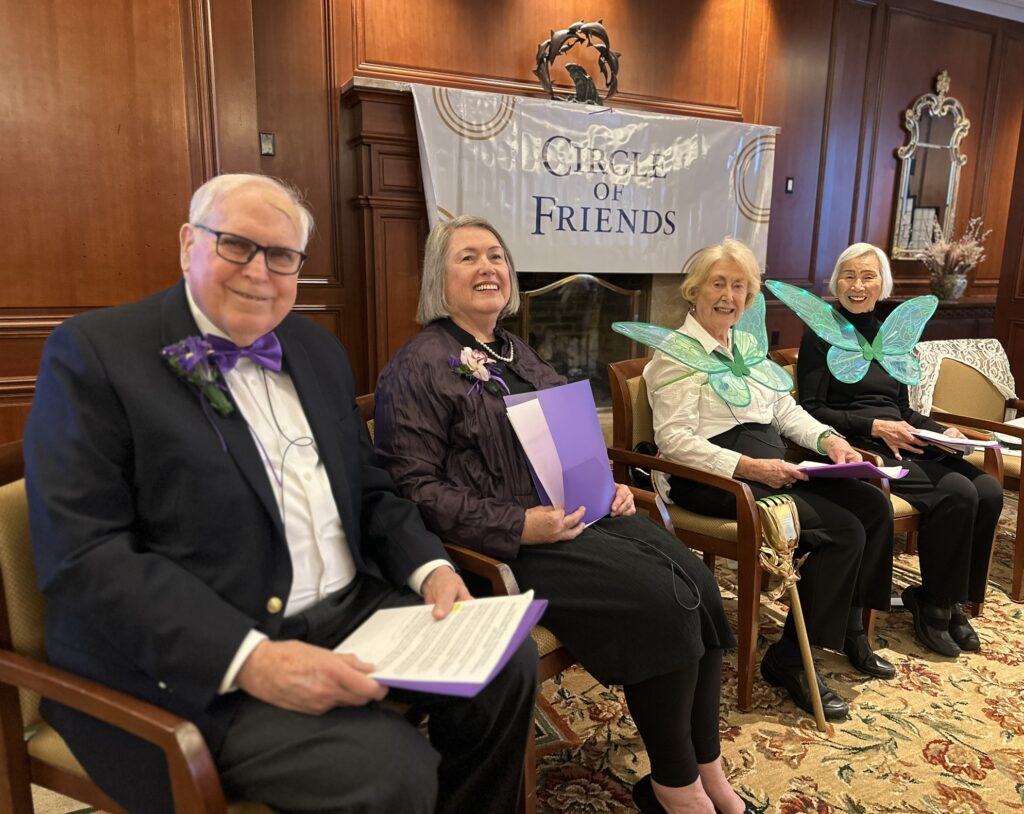
The Front Porch Communities Foundation Circle of Friends fund is one way Front Porch supports residents who have outlived their resources. Most residents who are supported by the Circle of Friends are women who need additional supportive care and have lived in their community on average for more than 16 years.
“As a nonprofit, we have the ability to leverage philanthropy to rally resources and fund initiatives that a for-profit model might not support,” says Hoerl. In addition to the Circle of Friends residents’ assistance fund, Front Porch supports pioneering community services programs that enhance independence and social connection, such as the Home Match home sharing program and Well Connected, a connection program offering support groups, classes and meetings by phone and online every day of the year.
“Front Porch’s commitment to community services programs as well as attainable housing opportunities is evidence of a successful, values-based nonprofit that is able to manage business affairs effectively while at the same time providing services to an incredibly diverse population of people from all walks of life,” Kelly says.
In addition to its commitment to innovative programs, Kelly believes that Front Porch’s increasing commitment to building a strong and welcoming culture is significant. “There aren’t many organizations that have stepped out and made a commitment to a new division devoted to culture and community,” he says. “This is a mission- and values-based commitment that requires a certain amount of foresight. It also requires a long view that allows for significant investments in a truly people-centered approach to service and work.”
“Front Porch is a nonprofit organization that distinguishes itself from others because of our dynamic culture,” says Pete Spencer, a resident at San Francisco Towers who also has been elected by fellow-residents to serve on the Front Porch Board of Directors. “Our emphasis is on the quality of life, not just the length of life. Strategic goals are based on our collective commitment to the value proposition that, as a community, we will thrive and enhance our lives far beyond what we could achieve as individuals.”
This focus on culture and community ties back to Front Porch’s mission, which in turn directly relates to how employees care for residents. “Our model is all about resident-centered care. We’re always asking, ‘What’s best for our residents?’ not ‘What’s best for the bottom line?’” says Hoerl. “This means we can focus on things like supporting our staff so they can provide better care, creating new wellness programs, and building a true community, because our residents are our first priority.”
Nonprofits often have a reputation for being low-paying. Front Porch addresses this by conducting annual market reviews to ensure that all employees are compensated appropriately in comparison to people in equivalent roles in the region where they work. But compensation is only part of the reason to work at nonprofits such as Front Porch.
“For me, it’s the direct connection between my work and making a positive impact on someone’s life,” says Hoerl. “There’s a deep satisfaction in knowing that your effort helps an organization care for people with real dignity and respect. It feels good to be part of something bigger than yourself, a mission that’s genuinely helping people.”
Kelly emphasizes that senior living is not a simple binary with one type of organization being good or bad. “In this time, every provider, nonprofits and for-profits, must continue to evolve programs, become more transparent, deliver on consistent person-centered experiences, manage systems at scale, demonstrate consistent quality service and care delivery, build strong healthcare partnerships, develop increasingly strong leaders and nourish cultures where every person can feel they belong,” he says. “As much as the distinctions between nonprofit and for-profit organization may not be conspicuous, it’s important that organizations such as Front Porch are aware of them and put them to work in order to be successful over the long term and generate the impacts that our missions call us to.”
Related Posts
 Front Porch
 Useful gifts for older adults in your life
What are useful gifts for older adults in your life? Holiday gift giving is often a difficult task, especially when you’re searching for a useful gift for parents or grandparents...
Read More
 Front Porch
 Kitchen trailer brings state-of-the-art cooking to Casa de Mañana and beyond
Front Porch has used a kitchen trailer before, but never one like the state-of-the-art customized trailer developed for Front Porch by ContekPro. (Click here for video.) Previously, when one of...
Read More
 Front Porch
 Embracing Our Values: A Celebration of Creativity and Community
Front Porch Gallery is an intergenerational art space in Carlsbad, California dedicated to creative opportunities for older adults and adults with disabilities. Jean Keane, Program Manager at Front Porch Gallery,...
Read More
Useful gifts for older adults in your life
Kitchen trailer brings state-of-the-art cooking to Casa de Mañana and beyond